SPEED RALLY
Fastest wins.Performance is primarily about completing a stage in the shortest time.
Regularity rallying is about precision rather than outright speed — but the way precision is measured is not the same at every event. This guide explains the big picture first, then the PC, SPC and CO terminology used by EZ Rally Timer.
A regularity rally is not a conventional speed rally. The objective is normally to follow a prescribed route while matching target times or prescribed average speeds as accurately and consistently as possible.
In FIA historic regularity rallying, for example, a regularity section tests a crew’s ability to maintain a precise average speed over a defined route. A section can include a start control, intermediate timing controls and a finish. Other events use different formats: some focus on maintaining an average speed across a section, while others score the accuracy with which a car reaches or crosses a particular timing point.
Performance is primarily about completing a stage in the shortest time.
Performance is about matching the organizer’s prescribed timing or average-speed requirement.
This distinction is consistent with FIA’s description of historic regularity rallying and with widely used regularity-rally terminology.
This is the most important point to understand before learning PC and CO terminology.
The organizer prescribes an average speed for a section. The crew uses distance and elapsed time to stay on schedule. Timing may be checked at intermediate or secret controls.
The organizer defines a target time or target moment. The crew is scored on how closely the actual passage matches that target.
Why this matters: the terms used at one rally may not map perfectly to another. “PC”, “CO”, “regularity test”, “time control” and similar labels can be event-specific. EZ Rally therefore treats the organizer’s definitions as authoritative.
The basic relationship is simple: if the organizer gives a distance and a prescribed average speed, the corresponding target time can be calculated.
At 18.0 km/h, a car travels 5 metres per second. Covering 40 metres therefore takes 8.00 seconds. In a real rally, the roadbook or organizer may provide the necessary distances, speeds, target times or tables directly; the exact procedure depends on the event.
This is why accurate distance measurement, timing and clear communication between driver and co-driver matter so much in regularity competition.
In the PC-style workflow supported by EZ Rally Timer, the crew aims to cross a defined line at a target moment. The difference between target and actual passage is the result.
Crossed 0.20 seconds before the target.
Crossed at the target moment.
Crossed 0.20 seconds after the target.
As the car approaches the line, the driver controls the car’s speed and position while the co-driver follows the timing information. In EZ Rally Timer, the countdown can continue through zero if the line has not yet been crossed. The app does not assume that reaching 0.0 means the car crossed the physical line.
When the car actually crosses the PC line, the co-driver taps. That tap records the crew’s passage in the Timer workflow and advances to the next configured control.
These labels describe the control types that can be entered in EZ Rally Timer. They should be read as app terminology for a supported rally workflow — not as universal definitions for every regularity rally in the world.
SPC marks the start used by the Timer for a configured sequence. The co-driver starts the sequence at the actual start. From there, the app follows the controls entered for that Day.
A PC is handled as a precision-timing point. The Timer shows relative timing to the target and continues past zero when necessary. The co-driver taps at the actual line passage.
A CO is handled differently from a PC. EZ Rally Timer presents absolute clock time for the control, and the co-driver taps at the actual passage. The organizer’s procedure determines how the control must be approached and recorded.
Think: “How close am I to the target moment?”
Think: “What is the actual clock time?”
The example below is illustrative, not a universal rally rule. Its purpose is to show how the three control types can form one Timer sequence.
The driver’s priority is driving: road position, traffic, speed, braking and the physical control line. The driver must not interact with EZ Rally while driving.
The co-driver manages the roadbook and timing information, communicates with the driver and operates the Timer when permitted by the event and local law.
Regularity rallying has developed across many countries, clubs and championships. The underlying idea — precision — is shared, but the implementation is not universal.
FIA historic regularity descriptions emphasize maintaining a prescribed average speed across a section, often with intermediate timing controls. Other events may use known timing lines, target-time tests, secret controls, TSD-style instructions or local terminology. A term that means one thing at one event may be used differently elsewhere.
Configure EZ Rally to match the event — never reinterpret the event to match the app.
Once you understand the event’s timing system, EZ Rally Timer helps present the information in a clear, purpose-built workflow.
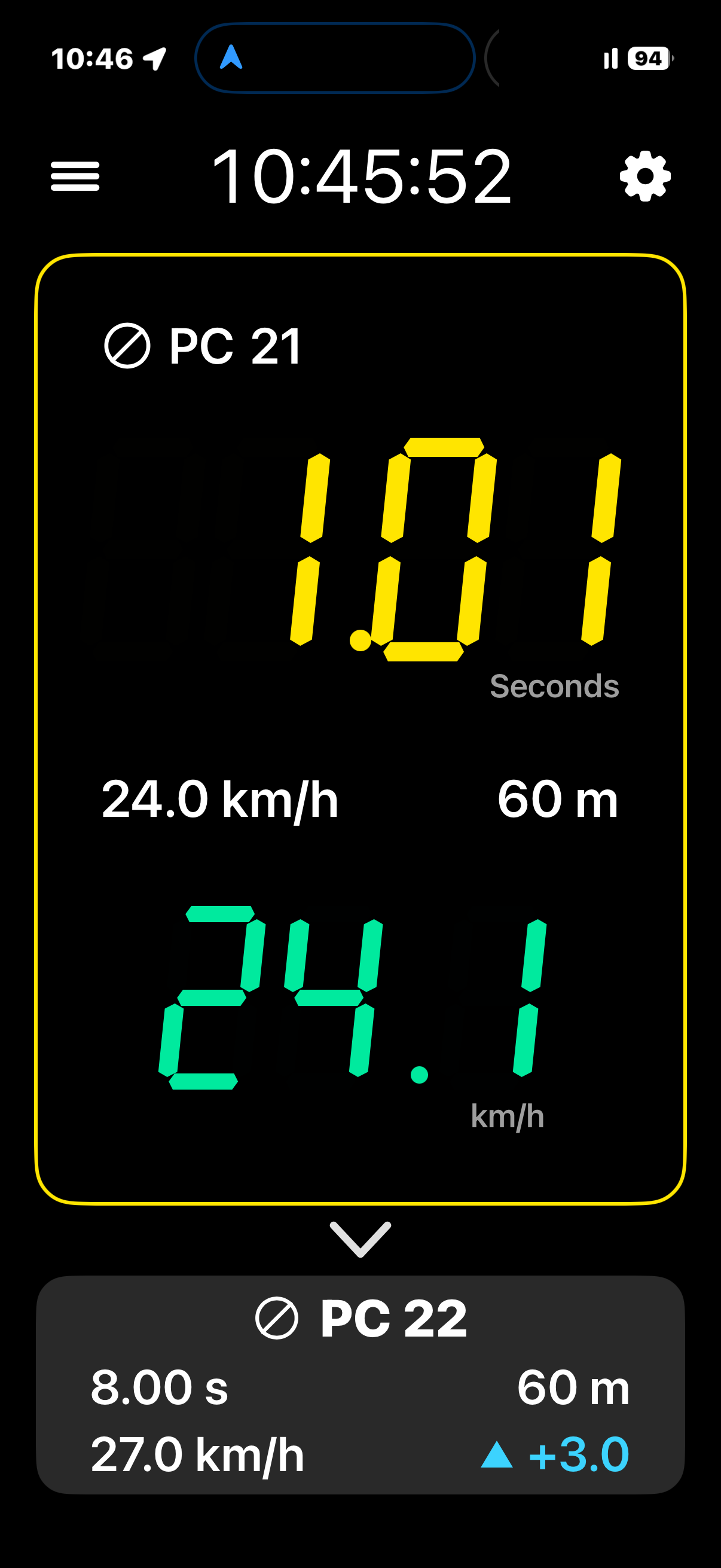
The main screen brings together the current control, remaining time, distance, target speed, current speed and the next control. The co-driver uses the actual line passage as the trigger.
Events, Days and controls are prepared in advance so the competition workflow stays focused and predictable.
EXPLORE EZ RALLY TIMER →This guide separates general regularity-rally principles from the PC/SPC/CO terminology used by EZ Rally Timer. For broader context, we recommend primary and specialist references:
EZ Rally is not affiliated with FIA or RallyGuide. External references are provided for education; the rules of the event you are entering remain authoritative.